Horse Bedding Waste for Biochar Production
Horse stable waste composting suffers from long fermentation cycles, odor emissions, high weed seed viability, low economic benefit and a large land footprint. Conventional disposal methods such as landfilling and incineration may also lead to serious environmental pollution.
According to research, experiments and analysis conducted by SIMEC, horse bedding waste proves to be an excellent feedstock for biochar preparation. It is rich in lignocellulosic components (such as sawdust, wood chips and hay), contains high organic matter and abundant nutrients (including N, P, K derived from manure and urine). Its favorable thermochemical characteristics enable high carbon conversion, well-developed pore structure and large specific surface area after pyrolysis. Meanwhile, it achieves waste resource utilization, pollution mitigation and carbon sequestration. With proper pretreatment such as drying and controlled pyrolysis at 400–600 °C, it yields high-quality biochar suitable for soil amendment, environmental remediation, and carbon sequestration.
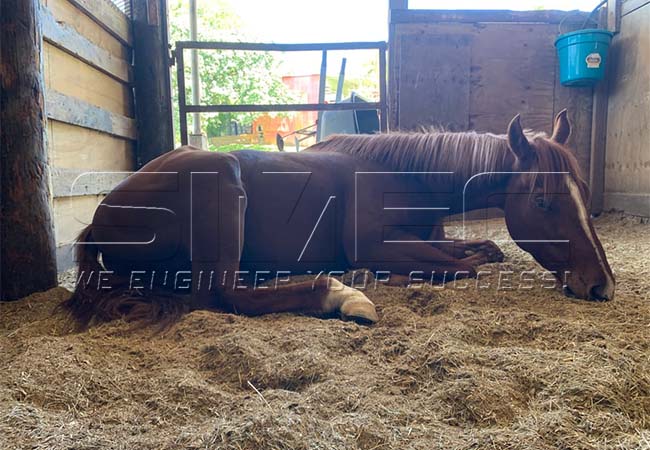
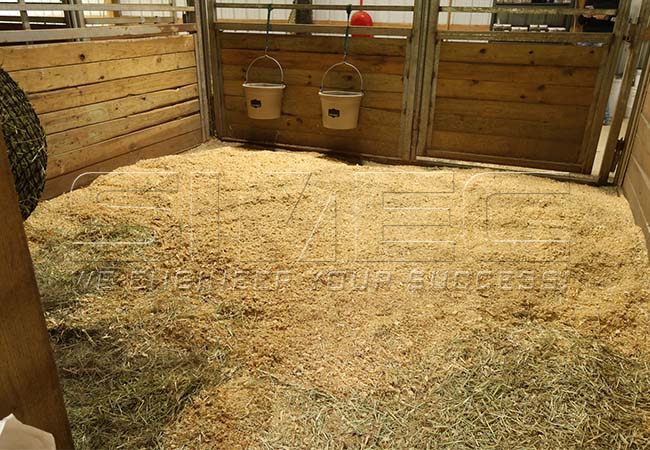
Most horse stables at Hong Kong racecourses utilize wood shavings for bedding, with only a few using shredded newspaper strips. Both types of soiled bedding contain hay residues of assorted lengths. The grab trucks, waste compactors and dumpsters are employed to collect and dispose of stable waste. Upon site investigation, the stable waste may contain soiled bedding, hay, manure, urine, and even sand, soil or other impurities. All materials are randomly mixed together in an uneven distribution.
For more information on biochar production technology, please see the details below.
| Applicable Material | Mixed solid waste collected from horse stables. Its main components consist of horse manure, urine residues, bedding (straw, wood shavings, sawdust), waste forage and hay fragments. |
| Unacceptable |
Municipal garbage, plastic, metal, stones, construction waste, toxic contaminants. The above-mentioned material shall be sorted and removed from SIMEC biochar production process. |
| Feedstock Acceptance Criteria | |
| Moisture Content | Fresh stable waste: 60–70% MC |
| Particle Size |
Raw material: highly variable (0.5 mm – 30 cm). Long straw/hay, large clods, compacted lumps |
| Impurity Limits |
Sand, soil, silt: ≤ 5% Plastic, metal, glass, rope, stones: zero tolerance Severe mold, rot or putrid odor: rejected |
| Composition Stability |
Non-uniform mixture of manure + bedding + forage C/N ratio: 30–40:1 (suitable for direct pyrolysis) Ash content: 15–25% |
| Process Flow of SIMEC Biochar Production Line | |
| Stable Waste Receiving & Sorting |
Moving floor silo system for raw material receiving. Automatic unloading and feeding to downstream process. To sort and remove the unacceptable material. |
| Shredding & Homogenization |
Coarse crushing to break manure clumps and cut long straw/hay. Perform conditioning to homogenize moisture content and particle size. |
| Pre-Drying & Screening |
Containerized drying module. No additional fuel required, recovery of excess heat from pyrolysis process. |
| Pyrolysis |
Containerized pyrolysis module. Startup by biomass pellets. |
In the SIMEC pyrolysis reactor, the spent horse bedding material undergoes thermal decomposition and compositional conversion, yielding high-grade biochar for use as an effective soil amendment. The biochar can improve soil porosity and aeration, enhance water and fertilizer retention capacity, activate soil microbial activity, and simultaneously adsorb and solidify heavy metals and organic pollutants in the soil.
The SIMEC pyrolysis technology can effectively control the formation of harmful byproducts: polycyclic aromatic hydrocarbons (PAHs). To comply with the EU's stringent PAH control standards (≤0.4 mg/kg), the SIMEC process stably maintains PAH levels in biochar below 0.2 mg/kg, well below the regulatory threshold.
SIMEC biochar production technology covers both pilot-scale facilities and large-scale biochar plants, with a processing capacity ranging from 100kg/h to 10t/h.
© Copyright of articles and pictures on this site belongs to SIMEC. Any company, media, website or individual are not allowed to reprint, reproduce, repost, modify or use in other ways without permission. Otherwise SIMEC will have the right to pursue legal responsibilities.